Alarm Monitoring & Response
When your alarm trips, an officer answers — not just a siren
A siren scares nobody who’s done this before. What changes the outcome is what happens next: a monitored signal, a dispatched officer, a property checked and secured, and a report in your inbox by morning. We provide the system and the response behind it.
The problem with siren-only alarms
An unanswered alarm is a countdown nobody is watching. The siren sounds, the neighbors ignore it, and the intruder — who knows the averages better than most owners do — keeps working. Meanwhile the notification lands on a manager’s phone at 2:40 a.m., and now your least-equipped person is deciding whether to drive out alone to meet whatever set it off. Every part of that sequence is wrong, and every part of it is fixable with monitoring plus a trained responder.
The system: proven intrusion detection
We deploy Honeywell-based intrusion systems — established, serviceable commercial equipment rather than an experiment on your building:
- Door and window contacts on the openings an intruder actually uses, signaling the instant one is forced
- PIR motion detection covering interior spaces, catching movement past the perimeter
- 24/7 monitoring — every signal lands at a staffed desk with your site’s procedures attached, at any hour
- Zoned configuration — so a signal says which door, which room, which floor, and the response starts with information instead of a search
What an alarm response looks like, step by step
| Step | What happens |
|---|---|
| 1. Signal | The activation arrives at monitoring with its zone — which contact, which detector — and your response procedures. |
| 2. Dispatch | An officer is dispatched to the property while notifications go out per your call list. |
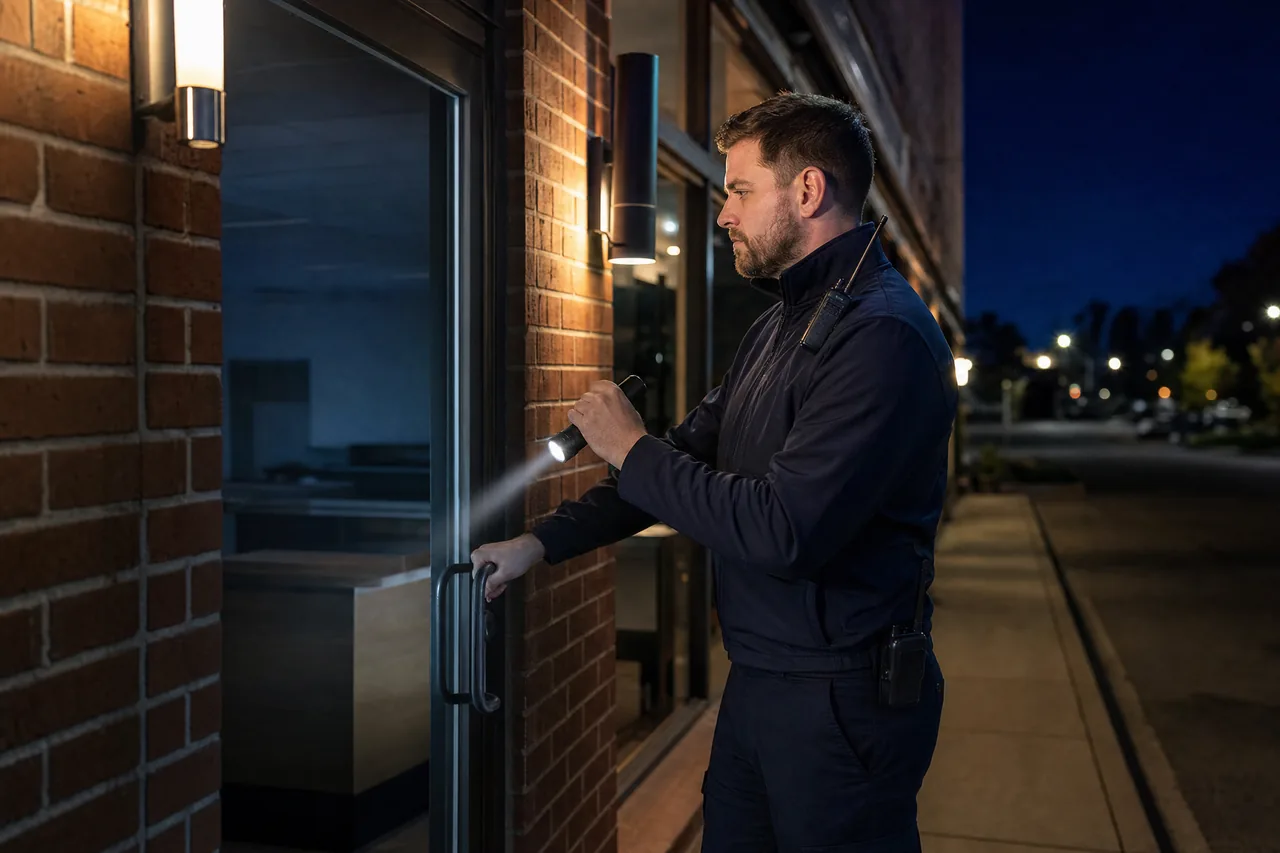
| 3. Exterior check | Doors, windows, and entry points inspected for pry marks, broken glass, and forced hardware; the triggering zone gets first attention. |
| 4. Interior check | Where you’ve authorized entry, the officer clears the interior methodically — and stages for police instead if there’s evidence of a crime in progress. |
| 5. Secure | Doors relocked, the system reset where appropriate, and a compromised opening boarded, blocked, or held until it can be secured. |
| 6. Keyholder coordination | Your contact reached with facts — what tripped, what was found, what’s been done — and involved only when a decision actually needs them. |
| 7. Documentation | A time-stamped incident report with photos, whether the cause was a burglar or a balloon over a motion detector. |
Why the officer matters
Police departments triage unverified alarm calls behind everything else — understandably, given how many are false. A responding security officer changes the equation on both ends: false activations get identified, documented and closed without burning anyone’s night, and real intrusions get a trained observer on scene who can give police a verified crime, a description, and preserved evidence instead of a guess. Verified calls get taken seriously; that’s the whole game.
From survey to first signal
- Site survey. We walk the building and map the openings and interior zones that need coverage — and note the ones that don’t, so you’re not paying to protect a broom closet.
- System design. Contacts, motion coverage and zoning laid out in a written proposal, alongside the response procedures that will govern activations.
- Procedures on file. Your call list, entry authorization, escalation thresholds and keyholder arrangements are documented before monitoring goes live — the 3 a.m. decisions get made in daylight.
- Live monitoring. Signals answered around the clock from day one, with response and reporting exactly as written.
One layer of a monitored property
Alarm response covers the moments cameras and patrols don’t: the interior spaces, the forced door at 3 a.m., the seconds after a breach. Most clients run it alongside mobile patrol — the same officers covering scheduled visits and alarm calls — and many pair it with remote video monitoring so an activation comes with live eyes on the property before the officer arrives. It suits commercial buildings, retail plazas and warehouses across Worcester and Central Massachusetts, and the full detection-to-report stack lives on our technology page.
Alarm response questions
What does the officer actually do when our alarm goes off?
Respond to the property and work it methodically: an exterior check of doors, windows and entry points for signs of forced entry; an interior check where you’ve authorized entry; securing whatever can be secured; coordination with your keyholder and with police if there’s evidence of a break-in; and a documented report with photos either way. You wake up to an answer, not just a notification.
Do we have to drive out ourselves at 3 a.m.?
That’s exactly what this service exists to end. Acting as your responding keyholder contact, our officer checks the property so your manager doesn’t meet an unknown situation alone in the dark. Your people get involved when there’s a decision to make — not for every activation.
What alarm equipment do you work with?
We deploy Honeywell-based intrusion systems built on PIR motion detectors and door/window contacts, monitored around the clock. If you already have an alarm system in place, call 508-803-6900 — whether we can take on monitoring or response for it depends on the system, and we’ll give you a straight answer once we’ve seen it.
What about false alarms?
False activations are a fact of alarm life — weather, cleaning crews, a door that doesn’t latch. The response protocol sorts them fast: the officer checks the property, identifies the likely cause, notes it in the report, and flags repeat offenders like a faulty contact or an unlatched door so the underlying problem gets fixed instead of waking everyone up weekly.