Warehouse & Industrial Security
Warehouse security built around the gate, the dock and the yard
Freight is at its most vulnerable when it’s moving — onto a dock, into a trailer, through a gate. We secure distribution and manufacturing sites across Central Massachusetts where it counts: disciplined driver check-in, dock and perimeter coverage during operations, and verified patrols after the last trailer door drops.
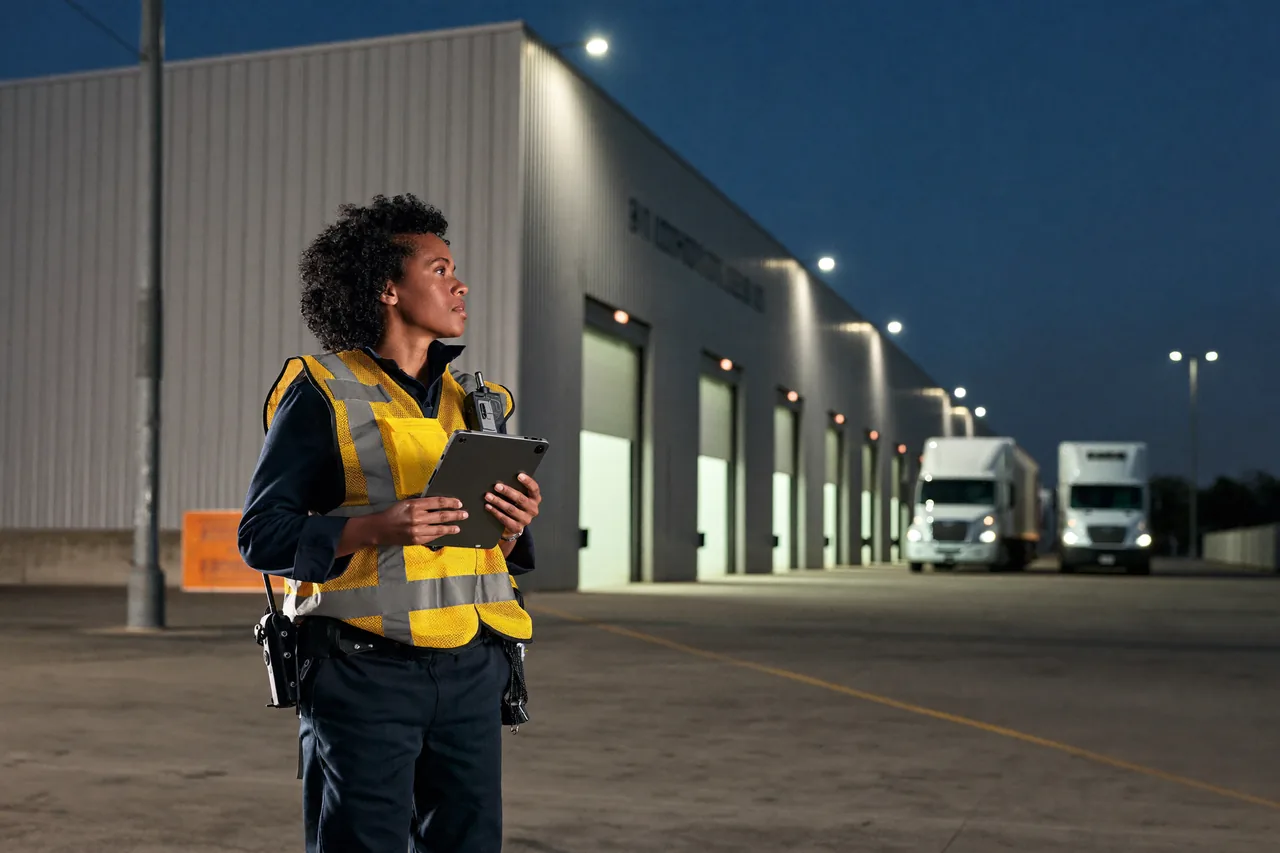
Cargo theft exploits process gaps, not fences
The image of warehouse theft is someone coming over the fence at midnight. The reality is quieter: a driver who was never verified, a trailer left loaded in the yard over a weekend, a dock door open to an empty dock plate, a pallet that leaves on the wrong truck with paperwork nobody questioned. Fences and cameras don’t close those gaps — procedure does, and an officer is the person who enforces procedure at the exact points where freight changes hands.
The gatehouse: your highest-value post
Everything that enters or leaves a distribution site rolls through the gate, so that’s where discipline pays first. A gate officer working real post orders turns your yard from an open lot into a controlled zone:
| Gate function | What the officer does |
|---|---|
| Driver check-in | Verify the driver and carrier against expected arrivals; unscheduled trucks wait until your team confirms them. |
| In/out logging | Tractor, trailer and seal details recorded on arrival and departure — the paper trail claims and investigations depend on. |
| Yard direction | Drivers routed to docks, staging or the waiting line, keeping the yard orderly and out-of-place vehicles obvious. |
| Visitor & contractor control | Non-freight arrivals checked in, badged where required, and kept out of operational areas. |
| Departure checks | Outbound verification per your policy — seals, paperwork, and anything your loss-prevention program specifies. |
Dock and perimeter coverage during operations
- Presence on active docks — where loads are open, staged freight sits, and shrink actually happens
- Trailer yard checks — loaded trailers verified sealed and secured, drop lots walked on a schedule
- Perimeter and fence-line rounds with electronic checkpoint verification at the corners that matter
- Employee and visitor entrance coverage where your policies call for it
- Condition reporting — failed lot lighting, damaged fencing, doors that don’t seat — flagged before they become entry points
After hours: the yard doesn’t empty just because the shift did
Overnight is when a warehouse is most exposed — loaded trailers idle, docks quiet, and nobody around to notice a bolt cutter. Coverage options scale to the exposure: dedicated overnight posts for high-value inventory, randomized mobile patrol visits with lock and trailer checks for lower-risk sites, and AI-assisted video monitoring watching the yard continuously with live voice-down — backed by officer alarm response for the building interior. Most sites end up with a layered design rather than a single tool, because the yard, the dock and the racking each fail differently.
Central Massachusetts is a freight corridor — and it cuts both ways
Distribution clusters where the highways meet, and Worcester sits on the junction: I-290 through the city, I-190 north toward Leominster and Fitchburg, Route 146 running south to the Mass Pike and Rhode Island. That access is why the warehouses are here — and it’s also a fast anonymous exit for anyone leaving with your freight. Local coverage matters against that geography: our officers and patrol vehicles work from Worcester, not from a branch office two counties away, and our dispatch desk runs 24/7 — reachable at 508-803-6900.
What the walkthrough maps
Warehouse coverage is scoped on site, not from an aerial photo. Before we propose anything, we walk the facility with your operations lead and map:
- Gate flow — how drivers arrive, where they stage, and where a check-in post physically works
- Dock zones and the staging areas where freight sits open and unattended
- Trailer parking and drop lots, including what stays loaded overnight and over weekends
- The fence line, its gaps, and the corners that need checkpoint coverage
- Lighting, camera and alarm positions — what exists, what works, and where the layers should connect
- Your shift pattern, peak seasons, and the hours when the site is genuinely empty
Documentation your operations team will actually use
Every post produces a record: gate logs, checkpoint-verified patrol data, digital shift reports, and incident reports with photos. When a shipper disputes a load, an insurer questions a claim, or corporate asks what happened on the overnight, the answer is in writing with time stamps — not in somebody’s recollection. More on the operational side of our programs at warehousing & logistics.
Warehouse security questions
Where does warehouse theft actually happen?
At the seams. The dock during a busy shift, the gate when check-in is loose, the trailer parked loaded overnight, the trash run that leaves with more than trash. Very little of it is a stranger cutting a fence — most of it exploits a process gap, which is why our coverage is built around the gate, the dock and the yard rather than just walking the floor.
Can your officers run our gate and driver check-in?
Yes — gatehouse posts are core warehouse work. Officers verify drivers against expected arrivals, log tractor, trailer and seal details in and out, direct drivers to docks or staging, keep unscheduled visitors off the yard, and document every movement. A disciplined gate is the single highest-value post on most distribution sites.
Our facility runs around the clock. Can you match our shifts?
Yes. Posts are staffed to your operation — single-shift, nights-and-weekends, or continuous 24/7 coverage — and the post orders change with the operational tempo, since a gate at peak receiving runs differently than a quiet yard at 3 a.m.
Do we need a guard if we already have cameras and an alarm?
They solve different problems. Cameras and alarms detect and record; an officer verifies drivers, controls the gate, watches the dock during operations and physically responds. The strongest sites integrate all three — and we can layer monitored cameras and alarm response with the guard program so nothing sits unwatched.